
‘Secrets of our Living Planet’
Presented by Chris Packham
Final episode:
BBC Two, 8pm Tuesday 17th July
Repeated 7pm Sunday 22 July 2012
……………………………………………………..
Bizarre relationships – New science
Ten million species live on Planet Earth
Each one is incredible
Yet none can live by itself
In this series, naturalist Chris Packham reveals the natural world in a way that you’ve never seen it before. For him, what is really beautiful about nature is not the amazing animals and plants that we share the planet with but the hidden relationships between them. These relationships may sound bizarre but without them, no life would be possible.
Chris reveals:
Why a crab in the swamps of Bangladesh needs a tiger
Why the mighty Brazil nut tree needs a rare orchid and a small rodent
Why a small gecko in Kenya needs a giraffe
Why the North American lynx needs a tiny moth caterpillar
In this, his first truly global series, Chris will travel to some of the planet’s most awe-inspiring ecosystems, in order to reveal the real beauty of nature.
Episodes:
1. The Emerald Band
Chris travels around the emerald band that encircles our planet – the jungles. And he begins by tackling one of the biggest puzzles about the world’s rainforests: why do these places have such a bewildering variety of life, far greater than any other habitat on Earth? His quest begins in Panama where more varieties of birds have been recorded in a single day than anywhere else on the planet.
He reveals that the key to the biodiversity of the rainforests is an almost constant climate. This allows insects and everything else that gorges itself on plants, to flourish all year round. So rainforest plants are under constant attack. The result is an unrelenting arms race, in which only the weird survive. Plants with barbs and poisons for defence; mammals, like the three-toed sloth which has evolved a way to digest leaves that nothing else can digest – even if it means taking days to digest them and moving as slow as, well, as a sloth. And then there are the Heliconius butterflies, that have evolved defence mechanisms against the cyanide of poisonous vines – absorbing the poisons into their bodies to use as a defence against their own predators. Chris reveals how evolutionary arms races in jungles have led to a riotous biodiversity of life.
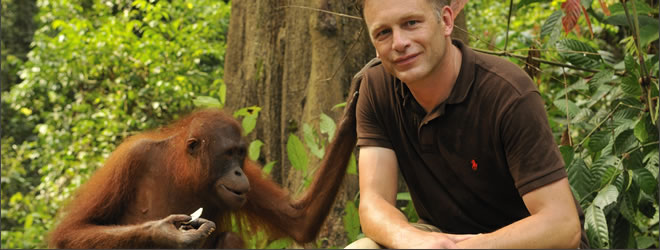
Chris travels to Borneo to see how some of the largest animals of the jungle, the orang-utan and the forest elephant are crucial in protecting this biodiversity, by spreading the precious seeds of jungle plants, far from their parent plants, to avoid attack by their predators.
He then travels to the Amazon to witness one truly amazing web of relationships centred around the Brazil nut tree. The ecosystem of this tree is too complex for it to be cultivated, so if you’ve ever eaten a Brazil nut, you too, are dependent on its ecosystem. It involves a small rodent, called an agouti, which the tree needs to disperse and plant its nuts, and a rare orchid which attracts a rare male bee, which in turn attracts a female, the only creature capable of pollinating the very fussy Brazil nut flower.
2. The Secret of the Savannah
Chris travels to the savannah of Kenya, the grasslands of Australia and the Cerrado of Brazil to witness how one of our most important ecosystems work – grasslands. The secret of grasslands is not what they have, but what they don’t have – and how they cope. Grasslands are lacking in one crucial nutrient. Nitrogen is the element necessary for all proteins, the building blocks of life. You can’t grow without it, yet nitrogen-poor grasslands around the world support some of the world’s largest animals. Something that’s only possible, thanks to the ways that these ecosystems ‘manage’ their nitrogen.
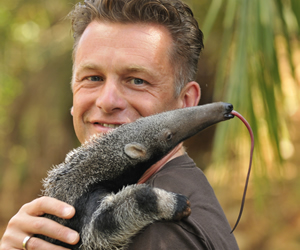
Chris travels to Kenya to see the surprisingly important role that rhinos play in making the grasslands fit for antelope. In the Brazilian Cerrado, he sees how maned wolves get by on a low nitrogen diet by gardening their own fruit. And how anteaters hunt the world’s richest source of nitrogen… not ants, but termites. In Australia, Chris encounters a weird cast of mini grassland characters, such as bandicoots and quols, driven to the edge of extinction by the introduction of alien species. Foxes and domestic cats have removed much of Australia’s natural grassland fauna and, as a consequence, the whole ecosystem has suffered.
Finally, Chris returns to East Africa to reveal how one extraordinary ecosystem works – that of the acacia tree. A gecko, a giraffe, an ant and a monkey all depend on this tree for their survival … but what’s really wonderful is how these individuals and the acacia also depend on the actions of each other.
3. The Magical Forest
Seasonal forests, such as those that cover the UK and most of North America, are special. Their ecosystems have to cope with drastic change twice a year, in Spring and Autumn. Not only do the inhabitants have to deal with the change, but the entire ecosystem has to transform itself – and it has to do this in perfect synchronicity.
In this episode, Chris spends all of his time in the vast seasonal forests of North America. Here, he sees why the whole forest depends on the Autumnal activities of a flying squirrel. And uncovers how the activities of an obscure moth caterpillar in Spring can mean the survival of the Canadian lynx in winter. Perhaps most amazing of all though, is how the great forests of British Columbia depend upon bears to catch salmon and take them into the forest, where their carcasses then fertilise its massive trees. Amazingly, up to 85% of the nutrients that feed these trees come from salmon. That’s how much the tree needs the salmon.
4. Waterworlds
In the final part of the series, Chris makes an epic journey, from the mountain streams of Iceland to the deep of the Indian Ocean, via the wetlands of the Pantanal in Brazil and the coastal swamps of Bangladesh. And on the way, he reveals how our most important ecosystems, overcome the daily challenge of living in medium that is constantly on the move.
He shows us how the Pantanal wetland in Brazil, while being a land of the giants (the world’s biggest snake, water lily, rodent, otter – you name it, they all live here), actually couldn’t work without the humble apple snail. Thanks to this animal, the Pantanal is able to recycle nutrients and regenerate itself in all its amazing glory, every year.
Chris then travels to the Sunderbans – a vast mangrove swamp at the mouth of the Ganges. After the Pantanal, it seems amazing that anything at all can live in what appears to be a sticky, sulphurous ooze. But, in fact, there is so much life here that this place supports a quarter of the world’s tiger population. Once again, it’s all down to a group of unsung heroes – the crabs on the beach. These animals dig burrows that not only supply oxygen and food to the roots of the mangroves; they also mix the toxic seawater with freshwater so that these trees can thrive.
Chris then heads out to sea, to the coral reefs of the Maldives. Here he investigates the puzzle of where reefs get their food. After all, their waters are crystal clear, so where are the nutrients? The answer comes in the very unlikely form of one of the weirdest animals on the planet. Sponges have no eyes or nervous system and can’t move. But what’s really weird is the way they eat their food. They pump seawater through their bodies at such a high rate that they are able to harvest enough nutrients, from the microscopic particles in the water. And, thanks to the sponges capturing these nutrients, the whole reef can thrive.
Chris then sails out into the deep ocean to reveal how ocean currents rescue much of the lost nutrients that end up on the seabed. These feed plankton blooms that attract our planets largest animals and –astonishingly – even influence the weather.
Chris Packham says:
My earliest memories are of discovering beauty in small things. The Ladybird that tickled my palm and pitched on the tip of my finger was formatively perfect. I still see and feel this about living things, and revel in it, but I have also recognised that a far greater, far richer beauty exists in the dynamic harmony of complex communities of life. This co-existence of all the little things defines the science of ecology and my ambition for Secrets of our Living Planet was to not only explain this but also to reveal to each viewer how astonishingly beautiful the result is.
Having watched Secrets of our Living Planet I want people to shift their appreciation of life up a gear, to reach another plane in terms of understanding its complexity, its fragility and its almost unbelievable beauty.
Many people like animals: some love them, some obsess about them. But generally, in isolation, they like tigers or otters or snails. What I want is to join everything up, to show that – as incredible as it may sound – there are real connections between these and, indeed, all things; and that without these relationships none could survive.
Understanding nature is not about knowing why birds sing, why bees buzz or why fish swirl in silvery shoals. It’s about being able to see the bigger picture, being able to see how all life is connected and, by unravelling the stories that link species, it’s also about developing a deeper more profound appreciation of life.
Secrets of our Living Planet was a challenging series to make on many levels; travelling to all the locations in a short shooting season, grappling with all the world’s climatic extremes and actually meeting the animals tested the team’s practical skills, and temperaments, to extremes. But perhaps our most difficult quest was telling our story; concisely and comprehensibly explaining the remarkable complexity of nature, truly portraying its magnificence and its subtle nuances so that viewers can see Secrets of our Living Planet.
For me it has been a chance to tell the greatest story ever told. To romp through some of the most amazing sub-plots and lead the viewers toward an awesome epiphany, to really explain how nature works. I want them to go ‘Aww’, go ‘Wow’, I want them to shed tears at the sheer beauty of it all.
I’m a no nonsense pragmatic scientist. But I know that the fuel for such a psyche is a deeply felt emotional response to nature, it’s that which makes me set my alarm clock, shiver, sweat, weep and bleed to encounter the World’s wild things. For me, understanding our planet’s secrets will never dull an appreciation of its unparalleled beauty because how it works is the most beautiful thing of all.
From snowfields to shoals of sand, from jungles to grassy plains, from waterfalls to sparkling reefs, we travelled our planet in pursuit of a cast of species which were equally as diverse: flying squirrels and manta rays; orchid bees and kangaroos; termites and Rhinoceros. I met an orang-utan, a three-toed sloth, a giant anteater and a host of crabs and snails. I saw tigers and jaguars, climbed to tropical tree tops and snorkelled with turtles. Every destination and encounter had a purpose – to unravel a remarkable tale of incredible connections between these animals and their environments. Connections, without which, they and we, simply could not exist.
—
Copyright: Adam White. Used with the kind permission of the BBC.



Fantastic programme! Please, please tell me what was the ‘hairy looking pig/warthog thing’ in the collection of strange species about 20 minutes in to the programme??
Thanks
)
Hi Dawn, I wondered the same thing. I think it could be a Bearded Pig.
Absoloutelt wonderful Chris Packham you have captured the nations imagination and understanding with this programme. Brilliant!
Just watched your first programme and am hugely impressed. Thank you for taking me and countless others where we can never hope to go, and allow us to see what we won’t otherwise see. Your sense of wonder and spectacle, I hope, will enthuse enough children.
Many thanks
Susie
Builth Wells, Powys
Absolutely brilliant,facinating,enthralling
Fantastic programme tonight. Please can you tell me if it is to be repeated during the week?
Please would you tell me if this programme to be repeated during this week?
Hi Sam, it’s now on iPlayer and it is listed as being repeated tomorrow (Monday) 11.20pm BBC Two. http://www.bbc.co.uk/programmes/b01k740l
Thanks for your comments.
A brilliant and fascinating programme. I’m looking forward to the next 2 programmes already. Some stunning filming, and as ever Chris finds ways of explaining complex processes in an easy to understand way.
Wow – wow – Chris at his best – what a fantastic programme
Should be shown in schools – Chris explanation is so simple
Will watch it again tonight – cannot wait for next three
So beautiful to be able to experience what he is seeing
Great – Irene
absolutely brillant, enjoyed every minute, mind blowing stuff cant wait for the next one! When the Agouti was on there was a bird in the background that sent all us budgies chirping and squawking and we was quiet lol , just interested what bird it was?? from jools and the budgies xx
Worth the licence fee alone. Best and most informative programme I’ve seen for ages. Well done Chis and the BBC. I shall never look at a Brazil nut in the same way again!
PS Loved the gratuitous shots of the Harpy Eagle
Worth the licence fee alone. Best programme I’ve watyched in ages. Well done Chris and the BBC. I shall never look at a Brazil nut in the same way again!
PS Loved the gratuitous shots of the Harpy eagle too.
Please could you tell me how I can get the Open University information as I was unable to take down the details.
Absolutely great. This was a completely new slant on nature. Well done to Chris for explaining all this information so clearly. The camera work was amazing, and I learned so much in one hour. Margaret
Good stuff,you may well be the ‘natural heir’ to Sir David A.
Good stuff,you may well be the \’natural heir\’ to Sir David A.
Loved the programme ~ especially the Urang Utan, he looked so gentle and patient.
Please could you let me have the contact details for the leaflet/poster from the OU relating to this series?
The only bit I couldn’t watch was Chris sitting on the branch. Made me feel positively ill and I kept hoping he would descend safely to the ground.
Many thanks.
Wonderful first programme Chris(and team)Just look at the complexity of the relationships surrounding the brazilnut tree & then try to tell me that there is no such thing as evolution
Packham for PM!!
Wonderful first show Chris (and team) Just look at the complex relationships surrounding the brazilnut tree and then try to tell me that there is no such thing as evolution. Packham 4 PM!!
Fabulous, fascinating facts; beautiful images – best wildlife prog in a while for me! Thanks to all the team who helped bring it to our screens.
A thought – does a single plant species being so dependant upon another single animal species look like an evolutionary cul-de-sac for both species?
Can’t wait for next episode!!
Well done Chris. You are a natural presenter of wildlife.You were born to do it.Love all of the programmes you do especially ‘Secrets of a Living Planet’.
For sure an heir to Sir David.
Good Luck.
Brilliant series, should be made compulsory viewing, though some people still wouldn’t get it. Was recently at a flower show looking at the bee friendly area and overheard a woman saying quote ” I don’t want to encourage bees I want to get rid of them”! Can you believe it, if some people can not even make the connection between bees and plants they will never understand a whole eco system. People need to be educated now before it is too late and Chris is the one to educate them.
Brilliant series, should be made compulsory viewing, though some people still wouldn\’t get it. Was recently at a flower show looking at the bee friendly area and overheard a woman saying quote \" I don\’t want to encourage bees I want to get rid of them\"! Can you believe it, if some people can not even make the connection between bees and plants they will never understand a whole eco system. People need to be educated now before it is too late and Chris is the one to educate them.
Amazing new show, watching it via catch-up. Love the exploration of relationships between plants and animals within an ecosystem, very interesting. Also good pub facts, thanks Chris
Congrats on the BBC’s incredible footage, however Liz Bonnin, Martin Huges Games, and Dr Charlotte Ulhenbroek would all be appropriate presenters for this programme, there is only one David- Sir David Attenborough, and no one should try to copy him as seen in the episode, it doesn’t work especially with the voice of Packham, there is no natural warmth from this presenter, and the above mentioned are equally qualified in terms of university degrees. Any one who presents this programme should use their own personality and smile along with in depth knowledge of the complex interconnections of biodiversity. The BBC is far superior in elucidating and highlighting the fragility of our planet, with great respect to the BBC, if they are looking to find a similar presenter role as Sir David over the years, Chris Packham is NOT the person for it, keep him on springwatch where he works well with the help of the team. Any individual presenter has to have that special charisma to tell the story with knowledge and wisdom, but to also hold the publics attention.
Lion, While I agree with you that Sir David Attenborough has no equal, I disagree that Chris Packham is the wrong presenter. My husband and I (both biologists and wildlife enthusiasts) watched fearing yet another dumbed down documentary, but we were pleasantly surprised and learned stuff! Chris is knowledgeable and his love/respect for the natural world shines through, I think the public will be charmed, the documentary isin my opinion set at just the right level, Chris’s explanations are very clear and the message the world needs to hear, (everything is important in an ecosystem, we can’t continue to destroy the planet) comes across loud and clear. If you want to complain about poorly selected presenters have a go at Planet Earth Live! Julia Bradbury and worse Richard Hammond, we were so incensed they had been chosen over people with credentials in the field we wrote in, the response we received was that Hammond is interested in wildlife, he did a project once in school……
Lion, While I agree with you that Sir David Attenborough has no equal, I disagree that Chris Packham is the wrong presenter for this series. My husband and I (both biologists and wildlife enthusiasts) watched fearing yet another dumbed down documentary, but we were pleasantly surprised and learned stuff! Chris is knowledgeable and his love/respect for the natural world shines through, I think the public will be charmed, the documentary isin my opinion set at just the right level, Chris’ explanations are very clear and the message the world needs to hear, (everything is important in an ecosystem, we can\’t continue to destroy the planet) comes across loud and clear. If you want to complain about poorly selected presenters have a go at Planet Earth Live! Julia Bradbury and worse Richard Hammond, we were so incensed they had been chosen over people with credentials in the field we wrote in, the response we received was that Hammond is interested in wildlife, he did a project once in school……
Does anyone know what’s happened to the 4th episode? This is the most refreshing and perspective-changing nature series that I’ve watched since The Truth About Nature, I was really looking forward to the last episode. I just recieved the 4 OU posters about how nature works, and now the series seems to have vanished into thin air! All because of tennis, proably. Much good that turned out to be!
Congratulations Chris and everyone who has worked on this series, I think these are probably the best nature documentaries I’ve ever seen. Usually you just see the animals and how they behave, but learning about the ways that they are dependent on each other is so fascinating.
It is just so important that people understand how ecosystems work and the effect that losing a species can have, especially as we are losing biodiversity at an unsustainable rate.
Truly amazing show, beautiful breath taking scenes, beautiful documented, loved every second of every episode.
why dont people accept that chris is a naturalist and hes just doing a great job he isnt trying im sure to be like anyone else and why should he good stuff chris love to itchy and scratchy and keep up the good work…………
The show is fantastic and Chris Packham perfect for the job!!
Not sure what ‘Lion’ is on about?!!
Absoloutelt wonderful Chris Packham you have captured the nations imagination and understanding with this programme. Brilliant! I am a huge David Attenborough fan but I feel in this Chris reaches his standard and meets the public herad on. More please Chris.
The best ecology documentaries I can remember, presented by a genuine scientist with deep personal commitment and enthusiasm. In a cultural atmosphere where ecology is actually subject to Clarkson-type disdain and denial, Chris brings a programme of clarity and lucidity to a subject that has been locked in text-books for too long. Series 2 please asap!
Is this series available on dvd ?
With respect to anyone who has ever made a ‘nature’ programme, these four films stand on the shoulders of giants and then show exactly what it is we stand to lose and are losing by our ‘civilising’ of each square mile of our planet.It is worth reading Cristina Eisenbergs book ‘The Wolfs Tooth’, which goes into great depth about ‘trophic cascades,, keystone predators’ and her work with Michael Soule in ‘rewilding’ America, which is being obstructed by politics, as in the current wolf de-listing programme. The wolf chases the elk, which would otherwise strip the aspen, which denudes the area and affects the songbirds etc. etc.
This to me, is the web of life in action, the one Native Americans have known of for thousands of years and which most of us are ignorant of to our detriment. These films should be toured Chris, yes toured around the world for people to know and understand what it is that keeps us here and binds us. Lose these connections and species and we may well fade from history. As E O Wilson says we are on the verge of a sixth extinction and as Aldo leopold said, ‘to keep every cog and wheel is the first precaution of intelligent thinking’.
Out of interest, are you aware of any such ‘web of life’ systems which I could study here in the UK or in Europe?
Please BBC, repeat these programmes, I bought the dvd (is a book forthcoming?)
‘In wilderness is the preservation of the world’ – Thoreau.
Greatly enjoyed the programmes; fascinating ” connections”. Echoing a previous comment – is a book forthcoming?
Further research draws me to the Red River Hog. I hope this helps.
Hi Neil, we have been told ‘Waterworlds’ is being broadcast on Tuesday 17th at 8pm and repeated on Sunday 22nd July at 7pm – BBC Two.
Hi, I have thoroughly enjoyed this series, and was annoyed that episode 4 went missing. Thank you for finding it for me!! Vanessa.